

Longzhao Custom Golf Bag Factory has positioned itself at the intersection of craftsmanship and responsibility, offering custom golf bags designed to minimize environmental impact without compromising on performance, durability, or aesthetic appeal. In a world where consumers increasingly demand transparency about product origins and sustainability, Longzhao’s approach demonstrates how a manufacturing partner can reduce the carbon footprint of a seemingly niche product category—custom golf bags—through thoughtful material choices, optimized production processes, and supply chain innovation.
Understanding Carbon Footprint in Golf Bag Production
Before exploring Longzhao’s specific strategies and offerings, it helps to clarify what “carbon footprint” means in the context of golf bag manufacturing. The carbon footprint of a product generally refers to the total greenhouse gas (GHG) emissions (measured as CO2-equivalents, CO2e) associated with the product’s lifecycle: raw material extraction and processing, component manufacturing, assembly, transportation, usage (relevant for products consuming energy during use), and end-of-life disposal or recycling.
For golf bags, the primary emissions sources are:
– Materials (textiles like polyester/nylon, leather, metal hardware, foam padding, plastic zippers and buckles).
– Manufacturing energy (electricity and thermal energy in cutting, sewing, and finishing).
– Transportation (components to factory, finished backpacks to distributors and customers).
– Waste and end-of-life (landfilling vs recycling rates).
Secondary contributors include packaging and administrative operations.
Longzhao’s strategy is to target the most material contributors—textiles and manufacturing energy—while optimizing logistics and enabling circularity where possible.
Material Choices: Low-Carbon Alternatives and Their Trade-Offs
Material selection is the single most impactful lever to reduce cradle-to-gate emissions for golf bags. Longzhao sources and offers several alternative materials, with conscious choices balancing carbon footprint, cost, performance, and aesthetics.
Key material strategies:
– Recycled polyester (rPET): Made from recycled PET bottles or textile waste. rPET typically reduces cradle-to-gate emissions by 30–70% compared with virgin polyester, depending on process efficiencies and electricity mix.
– Organic and recycled cotton blends: While cotton can be water-intensive, organic and recycled cotton reduce the need for synthetic fertilizers and lower embodied carbon when compared to conventionally grown virgin cotton.
– Bio-based nylons and polyamides: New bio-feedstock-based nylons can reduce fossil-derived emissions, though availability, cost, and performance variability must be managed.
– Natural or plant-based leathers (e.g., cork, mushroom leather alternatives): These can reduce emissions and avoid animal agriculture impacts, but durability and consumer acceptance are considerations.
– Lightweight, high-strength fabrics: Reducing weight reduces material use and transport emissions. Longzhao offers design-for-weight-reduction as part of custom options.
– Recycled metal hardware and biodegradable plastics: Where feasible, using recycled metals (zinc, aluminum) and engineered biodegradable polymers for certain trims helps cut footprint.
Trade-offs to recognize:
– rPET reduces carbon but can have microplastic concerns; Longzhao mitigates this by using tightly woven face fabrics and integrated lining techniques.
– Bio-based and novel materials may increase cost or have limited color/finish options.
– Lighter materials can reduce durability if not engineered properly; Longzhao emphasizes performance testing.
Manufacturing Efficiency and Energy Management
Material improvements must be paired with cleaner, more efficient manufacturing processes. Longzhao focuses on three core manufacturing levers:
– Energy sourcing and efficiency: Upgrading to energy-efficient cutting machines, LED lighting, variable speed motors, and high-efficiency sewing equipment reduces electricity consumption. Where possible, Longzhao integrates on-site renewable energy (solar PV) or sources green electricity through supplier agreements to lower grid-carbon intensity.
– Process optimization: Nesting optimization reduces fabric waste. Computer-aided cutting patterns and standardized module design for custom bags minimize scrap. Standardizing sub-assemblies across different bag models also decreases changeover time and energy wasted on setup.
– Waste reduction and reuse: Offcuts are collected and diverted to downcycling streams (e.g., padding or accessory production). Longzhao has implemented a material reclamation loop for textile scraps to be processed into insulation or stuffing material.
These actions reduce per-unit manufacturing emissions and cut operating costs—savings that can be shared with clients.
Design for Lower Carbon: Customization That Reduces Emissions
Customization often implies more variety and potentially higher emissions due to small-batch production. Longzhao has designed a customization system that preserves personalization while minimizing environmental impact.
Key design principles:
– Modular design: Using interchangeable modules (pockets, straps, base units) reduces unique part counts and allows mass production of common pieces, reducing per-unit emissions.
– Digital sampling and virtual prototyping: 3D renders and virtual samples reduce physical sample shipments and waste.
– Lightweight engineering: Optimizing internal structures and padding placement minimizes material use without sacrificing protection.
– Standardized colorways for small orders: Offering pre-approved eco-friendly dye options reduces smaller-scale dye runs that can be energy-intensive.
– CO2-aware options: Clients may choose “low-carbon” component packages (e.g., rPET fabrics, recycled hardware) when configuring custom designs.
This approach allows premium personalization while maintaining the carbon-efficiency of larger production runs.
Supply Chain and Logistics: Reducing Transportation Emissions
Transportation is a significant slice of product footprint, especially for globalized supply chains. Longzhao addresses logistics through:
– Supplier consolidation: Sourcing multiple components from fewer, nearby suppliers reduces inbound logistics.
– Ocean freight optimization: Consolidated shipments and optimized container packing reduce shipping emissions per unit vs air freight.
– Localized assembly for regional clients: For high-volume regional partners, Longzhao coordinates partial assembly near distribution centers to minimize long-haul transport of bulky finished goods.
– Carbon-aware lead times: Educating clients that extended lead times allow shipping via lower-carbon ocean freight rather than air express.
Longzhao also supports carbon offsetting for unavoidable transport emissions while prioritizing reduction first.
End-of-Life and Circular Strategies
Reducing the impact of a product’s end-of-life is essential for lower lifetime carbon footprint. Longzhao incorporates circular principles by:
– Designing for disassembly: Using separable components and uniform fastenings helps recyclability.
– Implementing take-back programs: For larger B2B clients, Longzhao helps set up programs to take back worn golf bags for refurbishment or material recovery.
– Using mono-material constructions when possible: Simplifies recycling processes (e.g., a bag primarily made of recyclable rPET with minimal mixed components).
– Partnering with recyclers: Working with regional recyclers to convert textile waste into insulation or industrial inputs.
These options improve industry sustainability and create opportunities for brand differentiation.
Certifications, Transparency, and Reporting
Trust is essential. Longzhao supports clients in achieving transparent sustainability claims by:
– Collecting and sharing material provenance and third-party test reports.
– Supporting clients in product Environmental Product Declarations (EPDs) by providing bill-of-materials and process-energy data.
– Pursuing recognized standards where applicable (e.g., ISO 14001 for environmental management, Global Recycled Standard (GRS), Oeko-Tex, and factory audits), and enabling clients to specify certification requirements in their contracts.
Transparent reporting helps buyers make informed procurement decisions and supports sustainable marketing claims.
Economic and Market Implications for Buyers
Lower-carbon custom golf bags can have immediate and long-term business benefits:
– Premium pricing: Many consumers will pay a premium for sustainability-aligned products, enabling higher margins for brands.
– Cost savings: Energy and material efficiencies lower production costs over time. Recycled materials can sometimes be price-competitive, and reduced waste decreases disposal costs.
– Risk reduction: Sustainable supply chains are more resilient to regulatory shifts and reputational risks.
– Brand loyalty: Clients that demonstrate commitment to lower-carbon products can strengthen customer loyalty and open access to sustainability-focused sales channels.
Longzhao helps clients quantify trade-offs and ROI by providing scenario analyses for different material and process choices.
Case Studies and Client Scenarios
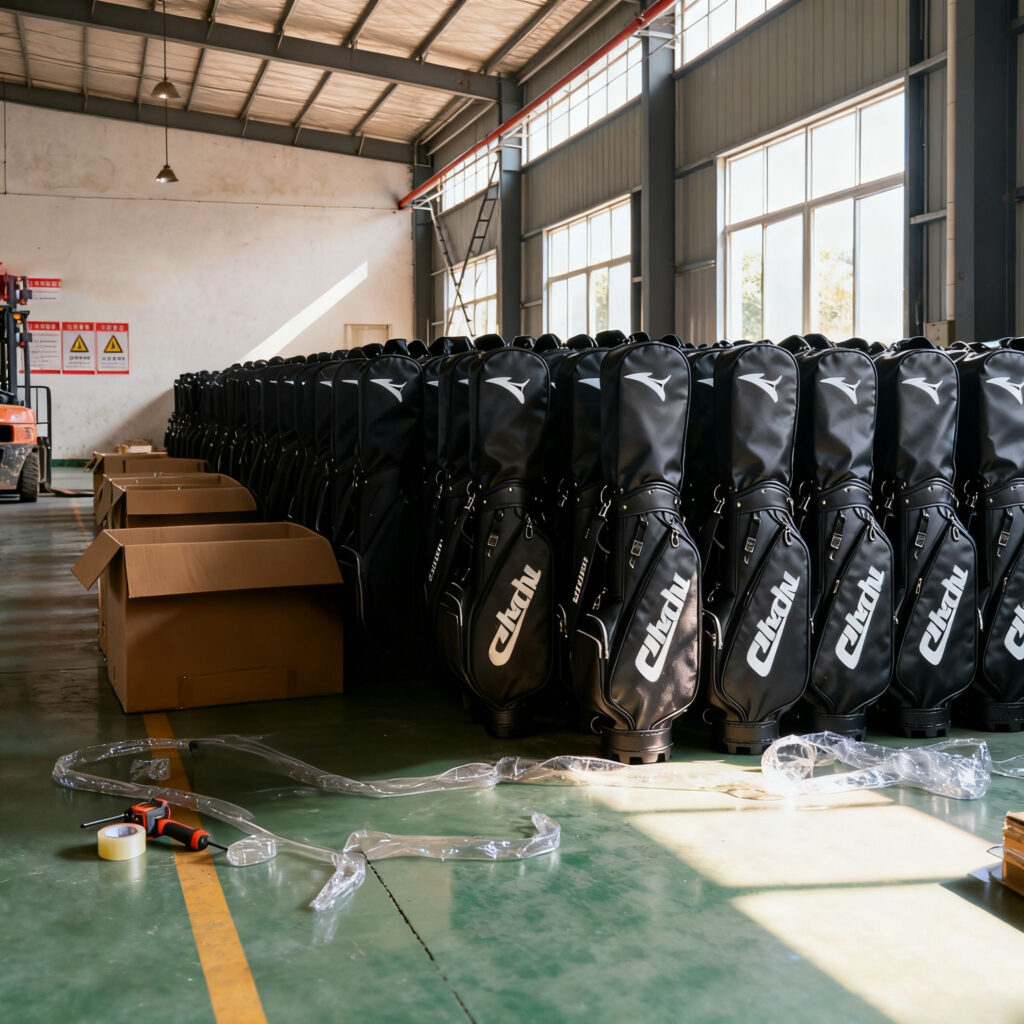
– Corporate Tournament Orders: A golf club ordering 500 branded bags opted for Longzhao’s rPET + modular pockets. By choosing optimized packing and ocean freight, the client reduced the total project carbon footprint by nearly 40% vs previous orders—while maintaining brand aesthetics and durability.
– Premium Retail Brand: A high-end brand required premium finishes but sought lower carbon intensity. Longzhao’s design team specified recycled metal hardware and leather alternatives for accents, combined with a partial on-site refurbishment program. The result: a sustainable product line that appealed to eco-conscious customers with limited compromise on luxury feel.
– Distributor Small-Batch Customization: A regional distributor needed many unique colorways but small volumes per variant. Longzhao employed color standardization with custom badges and modules to offer perceived customization while keeping carbon and cost impacts low.
Implementing a Low-Carbon Custom Golf Bag Program: Step-by-Step
For brands or buyers considering a transition, Longzhao recommends the following pragmatic steps:
1. Baseline assessment: Gather current BOM, manufacturing energy use, and transportation patterns.
2. Set targets: Define a realistic CO2e reduction target (e.g., 20–40%).
3. Material roadmap: Prioritize materials by impact and availability (start with rPET, recycled trims).
4. Prototyping and testing: Use virtual prototyping and reduced physical samples.
5. Production process upgrades: Implement nesting software, energy-efficient machines, and waste capture.
6. Logistics optimization: Consolidate suppliers, plan sea shipments, and optimize packaging.
7. Certification and transparency: Agree on reporting metrics and potential certification needs.
8. Launch and monitor: Track energy, waste, and shipment data; iterate improvements.
Longzhao supports clients through each step, providing technical assistance, cost models, and sustainability documentation.
Challenges and How Longzhao Addresses Them
Transitioning to low-carbon custom products is not without hurdles:
– Material availability: Longzhao maintains relationships with multiple vetted suppliers and forecasts demand to ensure supply continuity.
– Cost perception: While recycled materials can be cost-competitive, initial investments in process upgrades can be a barrier. Longzhao partners on cost-sharing and phased rollouts.
– Performance concerns: Any new material must meet durability requirements. Longzhao conducts rigorous lab and field testing before approving materials for production.
– Traceability and greenwashing risk: Longzhao emphasizes documentation, third-party testing, and transparent communication to avoid misleading claims.
Future Opportunities and Innovations
Looking ahead, innovations can further reduce carbon footprints:
– Advanced bio-based polymers that match performance of nylon and polyester with lower embodied carbon.
– Scalable textile recycling technologies enabling closed-loop cycles for golf bag fabrics.
– Greater factory electrification paired with renewable microgrids to decarbonize energy-intensive processes.
– Digital manufacturing and more localized micro-factories to decrease transport impacts.
Longzhao is actively exploring R&D partnerships to pilot such technologies and translate them into commercially viable solutions.
Why Choose Longzhao for Lower-Carbon Custom Golf Bags?
– Holistic approach: Longzhao combines material selection, process improvements, and logistics optimization rather than relying on a single tactic.
– Customization without waste: Modular systems and virtual sampling protect small-batch customization from high emissions.
– Data-driven transparency: Longzhao can provide bill-of-materials, process energy data, and support EPDs and supplier audits.
– Scalability: From boutique brands to large tournaments, Longzhao’s approach scales to client needs while preserving carbon benefits.
Practical Tips for Brands and Buyers
– Specify low-carbon options early in the design process to avoid costly rework.
– Ask suppliers for estimated CO2e per unit and BOM clarity.
– Consider total cost of ownership—energy savings and waste reductions often offset initial investments.
– Leverage storytelling—customers appreciate transparency and authenticity; detailed sustainability information enhances brand value.
– Pilot before full rollout: Start with a single product line or event order to test materials and logistics.
Conclusion: Balancing Performance, Customization, and Sustainability
Sustainability in sporting goods need not mean sacrificing performance or style. Longzhao Custom Golf Bag Factory demonstrates that with intentional design, material innovation, manufacturing efficiency, and supply chain coordination, it is possible to deliver custom golf bags with significantly lower carbon footprints. For brands, tournament organizers, and retailers, partnering with a factory that offers both customization capabilities and a sustainability roadmap provides a competitive advantage and aligns offerings with modern consumer values.
Longzhao’s practices—modular design, recycled materials, energy efficiency, and transparent reporting—show how a focused strategy can achieve measurable emissions reductions while maintaining product appeal. Whether you’re specifying a single bespoke bag or sourcing thousands for retail, considering carbon at every stage of the product lifecycle yields better outcomes for business and planet.