

The golf equipment market continues to grow and diversify, and golf bag organizers have emerged as a vital accessory for players, clubs, and retail brands who want to differentiate their product lines. Source Factory, operating under the LongZhao Custom Golf Bag Organizer OEM & ODM Service model, positions itself as a comprehensive partner for brands seeking tailor-made solutions—from early-stage design and prototyping to full-scale manufacturing, quality control, and logistics. This article explores their capabilities, design and production workflow, material and structural choices, quality assurance practices, value proposition for OEM and ODM clients, and strategic considerations for brands that want to develop private-label golf bag organizers. An analytical table further summarizes key service attributes for quick comparison.
Why Custom Golf Bag Organizers Matter
Golf bag organizers are more than simple accessories—they influence player experience, product perception, and retail differentiation. A well-designed organizer improves club protection, optimizes storage, reduces clutter, and upsells brand identity through materials, prints, and finishing details. For brands and retailers, custom organizers offer:
– Product differentiation: Unique compartments, reinforced sections, and smart accessories (e.g., integrated cooler sleeves, towel loops, or tool kits) can set a product line apart.
– Brand reinforcement: Logos, custom colorways, and materials (leather, PU, technical fabrics) communicate quality and brand story.
– Improved user experience: Ergonomics and functionality restore satisfaction for users who value durability and convenience.
Source Factory—Longzhao builds on these principles by delivering turn-key OEM and ODM services that address both functional requirements and brand storytelling.
Comprehensive OEM & ODM Services: From Concept to Shipment
Longzhao’s service model is structured to support different types of clients:
– OEM clients who bring their design and want manufacturing capacity and quality oversight.
– ODM clients who need end-to-end product development, from concept design to finished product, with options for branding and minor structural changes.
The standard workflow usually follows these steps:
1. Consultation and requirements gathering: Define target audience, budget, performance criteria, and aesthetic expectations.
2. Concept sketches and 3D renders: Industrial designers produce visuals to align on form, compartment layout, and materials.
3. Prototyping: Rapid prototyping methods (fabric swatches, CNC foam inserts, sample sewing) create working models.
4. Sample iteration: Fit, function, and finish are tested and adjusted; multiple rounds may be needed for complex requests.
5. Tooling and pre-production: If a new molded part (like EVA inserts or plastic clips) is required, tooling is created.
6. Mass production: Manufacturing follows agreed specifications, including labeling and packaging instructions.
7. QC and testing: AQL inspections, performance tests (zippers, seam strength, drop tests), and pre-shipment audits are conducted.
8. Logistics and after-sales support: Consolidation, documentation, and shipping arrangements are provided; warranty and defect resolution policies are established.
This turn-key approach is especially valuable for brands that lack in-house manufacturing expertise or want to accelerate time-to-market while retaining control over design and quality.
Key Materials and Construction Techniques
The performance and perception of a golf bag organizer depend heavily on materials and construction techniques. Longzhao emphasizes material science and process control to achieve durability and functional innovation. Common materials and methods include:
– Outer fabrics: Polyester 600D/1680D, nylon, ballistic nylon—chosen for abrasion resistance, color fastness, and weight.
– Leather and PU leather accents: Used for premium pockets, trims, and branding panels.
– EVA foam inserts: Offer rigid structure and shock absorption for club shafts and heads.
– Molded plastic parts: Reinforcements like bracket bases, feet, and hard pockets.
– Hardware: Custom metal or plastic zippers, magnetic closures, D-rings, and snap-fasteners.
– Linings: Water-resistant TPU or laminated fabrics for wet-weather protection.
Construction techniques such as double-stitching at load-bearing seams, ultrasonic welding for airtight and neat joins, and heat-sealing for waterproofing are standard practices. Material selection is driven by client priorities—cost efficiency, premium feel, or weatherproofing.
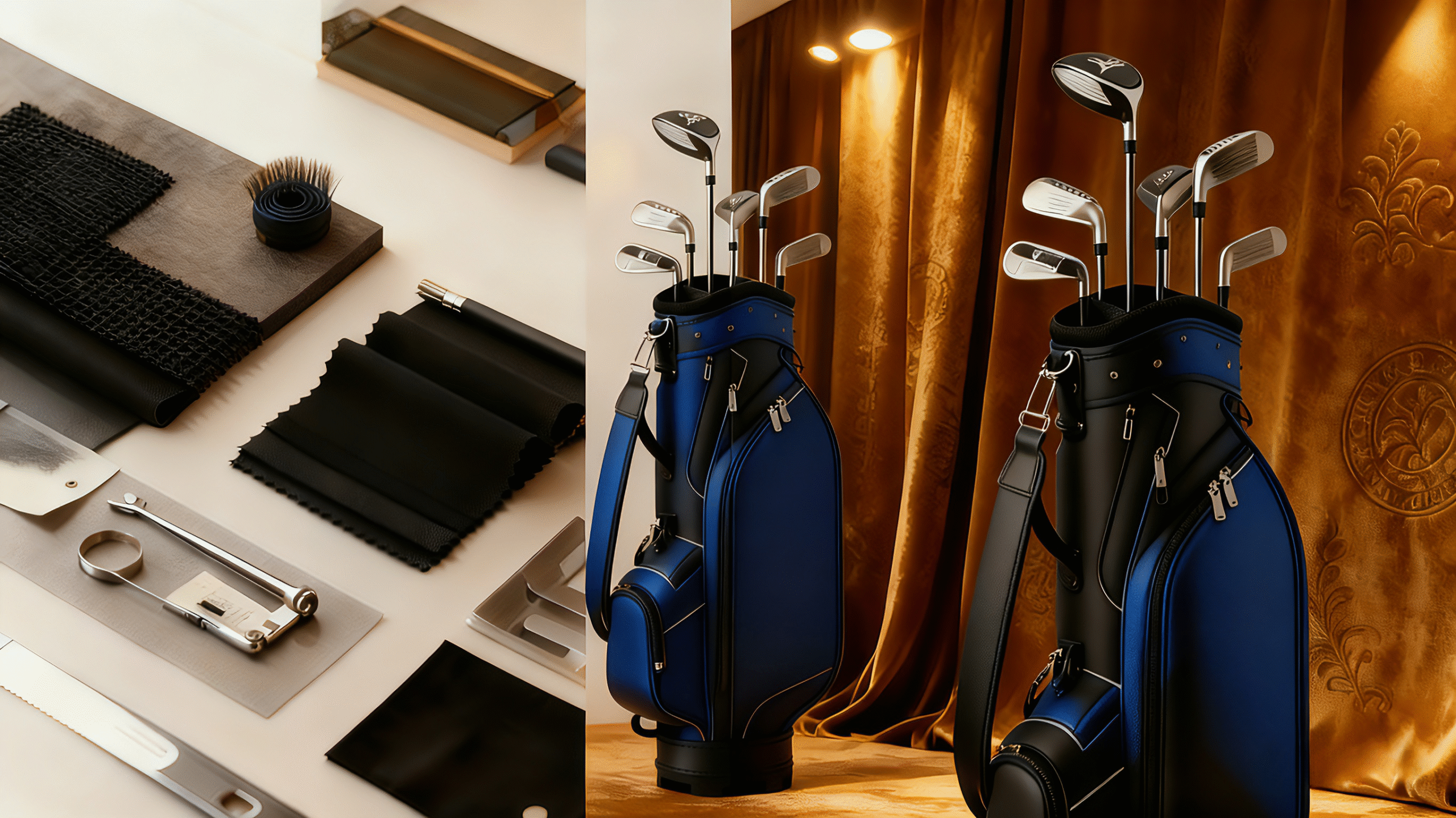
Customization Options: Function Meets Brand Identity
Longzhao’s customization offerings are extensive and tailored to brand needs:
– Compartment layout: Tailored slots for driver, wood, iron sections, putter sheathes, and accessory pockets.
– Removable dividers and inserts: Configurable EVA or foam inserts for modularity.
– Branding and decoration: Embroidery, debossing, embossing, woven labels, heat transfers, and silicone patches.
– Color and pattern: Pantone color matching, camouflage patterns, or proprietary graphics.
– Special features: Insulated cooler pockets, dedicated GPS pockets, integrated umbrella sleeves, trolley-compatible bases, or stroller straps for family-oriented models.
– Sustainable options: Recycled fabrics, water-based inks, and eco-friendly packaging.
These options enable brands to align product function with their market positioning—whether targeting luxury golfers, performance-oriented athletes, or casual weekend players.
Quality Assurance and Certifications
Quality control is an integral part of Longzhao’s service offering. The company applies recognized testing and inspection standards, often including:
– AQL (Acceptable Quality Level) inspections during production.
– Material tests: Tensile strength, abrasion resistance, colorfastness, and water resistance.
– Hardware testing: Cycle tests for zippers and closures.
– Product performance tests: Drop tests, load-bearing checks on straps, and seam tear tests.
– Environmental and safety compliance: RoHS and restricted substances checks for trims and hardware; ability to provide material certificates upon request.
For clients selling in regulated markets (EU, US, Japan), Longzhao assists with documentation and testing required for import compliance and retail standards.
Cost Structure and Lead Times
Cost and lead time depend on complexity, materials, and order quantity. Typical considerations:
– Prototype costs: Design and sample production, tooling for molds or custom hardware.
– Unit cost drivers: Fabric grade, custom hardware, labor intensity (hand-stitched details), and finishing processes.
– MOQ: Often tied to fabric roll quantities, custom hardware batches, or tooling costs; flexible OEM manufacturers may offer lower MOQs for standardized components.
– Lead times: Prototype (2–4 weeks), small-batch production (4–8 weeks), mass production (8–12 weeks), depending on seasonality and tooling needs.
Longzhao emphasizes transparent costing with clear breakdowns—material, labor, tooling amortization, and logistics—so clients can make informed decisions.
Supply Chain and Logistics Management
A reliable supply chain is critical for on-time delivery. Longzhao typically manages:
– Component sourcing: Securing consistent suppliers for fabrics, hardware, and finishings.
– Inventory management: JIT (just-in-time) arrangements or safety stock levels for peak seasons.
– Packaging and labeling: Custom retail-ready packaging, hang tags, and user manuals.
– Export documentation: Harmonized System (HS) codes, certificates of origin, and customs paperwork.
– Shipping arrangements: Sea, air, or multimodal freight solutions based on cost/time trade-offs.
These capabilities reduce friction for global brands that depend on predictable lead times and clear documentation.
Case Studies and Typical Client Profiles
Typical clients include:
– Established golf brands seeking private-label expansions.
– Startups launching a golf accessory line with limited capital but strong design concepts.
– Retailers and e-commerce entrepreneurs requiring small-batch manufacturing and quick turnarounds.
– Corporate and promotional clients needing branded organizers for tournaments and events.
Representative case outcomes often feature improved product margins via optimized materials, increased customer satisfaction due to better ergonomics, and faster product cycles enabled by streamlined prototyping.
Risks and Mitigation Strategies
Outsourcing production carries risks:
– Quality inconsistency: Mitigate via rigorous QC processes, third-party inspections, and sample approval gates.
– IP confidentiality: Mitigate through NDAs, segregated tooling ownership, and limited-access production lines.
– Lead time slippage: Mitigate by defining penalties, using buffer stock, and diversifying component suppliers.
– Cost overruns: Mitigate through defined-change orders, transparent cost breakdowns, and fixed-price tooling agreements.
Source Factory—Longzhao emphasizes open communication, formal contracts, and measurable milestones to help clients manage these risks.
Analysis Table: Longzhao Custom Golf Bag Organizer OEM & ODM Service

| Service Aspect | Typical Options | Lead Time | MOQ | Notes |
|---|---|---|---|---|
| Design & Prototyping | 2D/3D sketches, functional samples, colorways | 2–4 weeks | 1–5 samples | Multiple iterations common; digital renders speed approval |
| Materials & Hardware | Polyester/Nylon, EVA, PU/leather, custom zippers | Material sourcing 1–3 weeks | Varies by component (often 300–1000 pcs) | Eco options available; custom hardware increases lead time |
| Manufacturing | Sewing, ultrasonic welding, molding, assembly | 4–12 weeks | Production MOQ typically 300–1000 units | Time varies with complexity and season |
| Quality Control | AQL inspections, performance tests, material certificates | Concurrent with production; final inspection 1–3 days | N/A | Third-party inspection available on request |
| Packaging & Logistics | Retail packaging, bulk cartons, custom inserts | 2–4 weeks for custom packaging | Depends on packaging supplier MOQ | Freight options sea/air; documentation handled |
How to Work Effectively with Longzhao
To maximize value from an OEM/ODM relationship, follow these practical steps:
– Prepare a clear brief: Define target user, expected price point, must-have features, and visual references.
– Prioritize features: Identify which elements can be premium (e.g., leather accents) and which should be cost-optimized.
– Request a materials kit: Ask for swatches and hardware samples early to avoid costly changes later.
– Set sample approval gates: Define how many revisions are allowed and the criteria for acceptance.
– Establish communication cadence: Weekly updates, shared project management tools, and point persons streamline progress.
– Validate quality checkpoints: Include mid-production inspections and final random sampling.
– Negotiate IP and tooling terms: Decide whether tooling remains property of the client or the factory.
These practices reduce surprises and align expectations on both sides.
Competitive Advantages for Brands
Partnering with Source Factory—Longzhao offers several competitive advantages:
– Integrated capabilities: Design, prototyping, manufacturing, and logistics under one roof shorten time-to-market.
– Customization depth: From structural changes to branding finishes, high flexibility accommodates diverse brand needs.
– Cost transparency: Clear breakdowns and scalable options help brands manage margins.
– Experience in sports accessories: Familiarity with golf market requirements speeds development cycles.
For brands that prioritize control over design and consistent quality, these advantages translate into faster launches and stronger retail positioning.
Final Considerations
Whether you are an established golf brand expanding your lineup or a new entrepreneur entering the golf accessories market, selecting the right OEM/ODM partner is crucial. Source Factory—Longzhao’s full-spectrum service model is designed to lower the barriers to launching high-quality, branded golf bag organizers. Their strengths—material expertise, rigorous QC, flexibility in customization, and logistics support—address the core needs of modern brands.
Before committing, brands should conduct due diligence: request references, visit production facilities if possible, verify certification and testing capabilities, and start with a pilot run to validate processes. A well-structured partnership with an experienced manufacturer like Longzhao can transform ideas into market-ready products that resonate with golfers and retailers alike.